3.2.7 PatFindings
The PatFindings table in Supabase contains all diagnostic findings requested by the user for each patient case. Every diagnostic request is represented by a single row and inludes the examination group, item, and type, as well as the generated report. Each finding is linked to the corresponding patient via pat_id.
| Column | Format | Type | Description |
|---|---|---|---|
id | bigint | number | Unique ID of each finding |
pat_id | bigint | number | Corresponding patient case (as in PatBase) |
request_id | bigint | number | ? |
request_group | text | string | Diagnostic group (e.g., imaging, physical, microbiology) |
request_item | text | string | Diagnostic modality or item type (e.g., us, mri) |
request_type | text | string | Specific examination subtype (e.g., us_tv, mri_abdomen) |
data | jsonb | json | Generated report (including title, text, and optional images) |
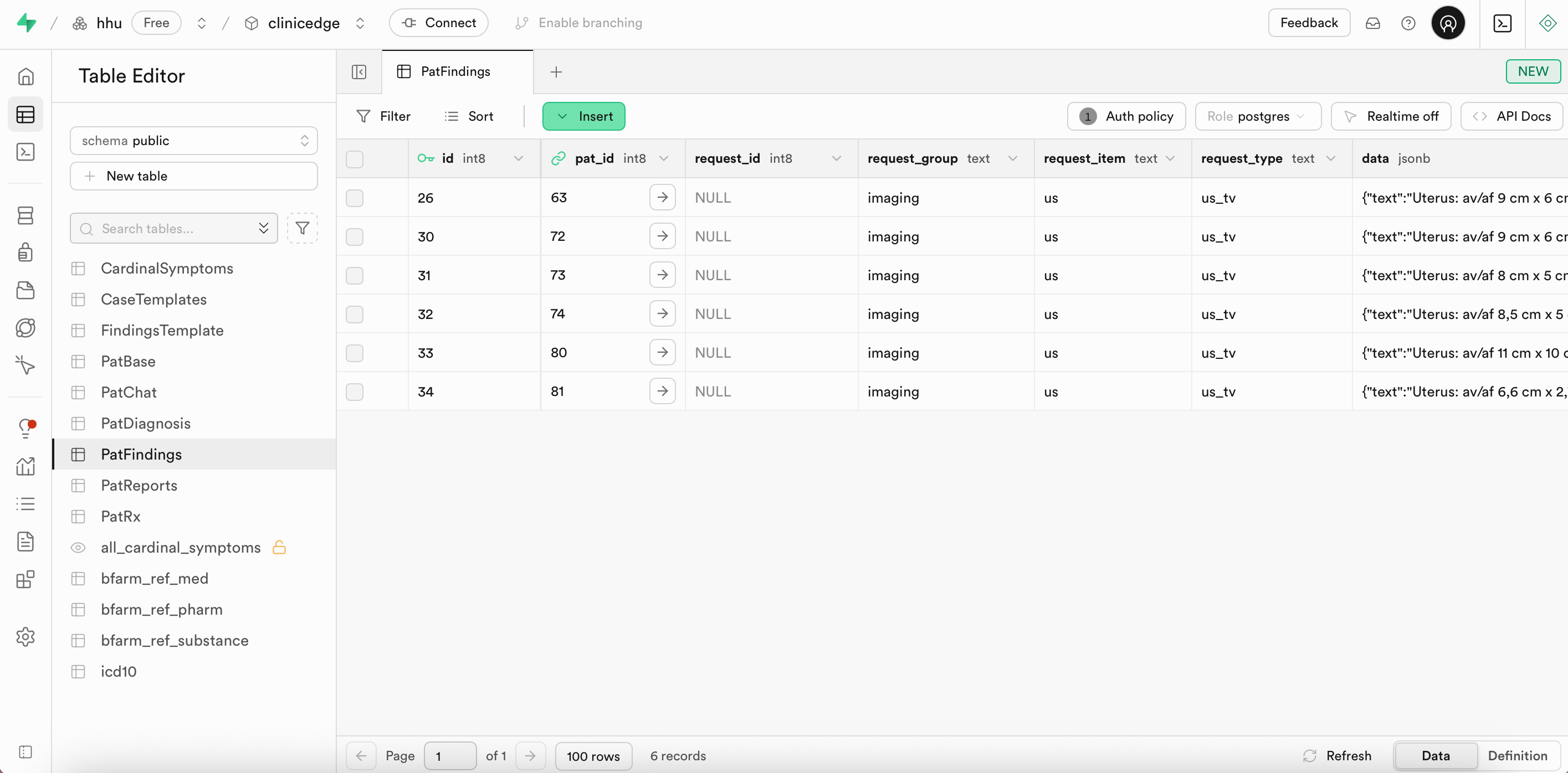
Example request:
request_group:"imaging"request_item:"us"request_type:"us_tv"
Example data:
{
  "text": "Uterus: av/af 9 cm x 6 cm x 3,5 cm; Endometrium flach. \n Ovar links: 3 cm x 1,5 cm x 1 cm, o.p.B. \n Ovar rechts: 3,5 cm x 2,5 cm x 1 cm; zystische, unscharf begrenzte ovarielle RF (2 cm x 1 cm x 1cm) in Form eines Tuboovarialabszesses; rechtes Adnex geschwollen. \n Zervix: o.p.B. \n Allgemein: Gute Ultraschallbedingungen.",
  "title": "Transvaginaler Ultraschall",
  "images": [
    "https://files.clinic-edge.org/images/tvus/test.jpg"
  ]
}
Integration within the System
When a user requests a diagnostic test (e.g., us_tv), the system first executes the requestFinding function, which then runs the generateFinding function in logic_server.js. The corresponding report template is fetched from the FindingsTemplate table in Supabase. Patient-specific findings are retrieved from pat_data in PatBase, and the findings and values are inserted into the report template as defined in vars and vars_path within the FindingsTemplate table. The final report is stored in the PatFindings table.